“Thank you so much for your mentorship in this internship Daniel, I learned a lot from you and from your design skills. I can even say I learned more from you than from some professors Ive had in Uni. I believe you are a great designer and I wish you all the luck in your Masters and everything you do in life 🥺”
Marina Cuellar Sanchez
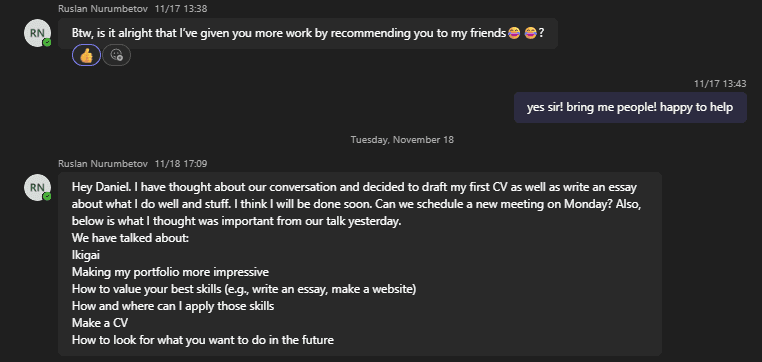
Information Design - Mexico“Hey Daniel. I have thought about our conversation and decided to draft my first CV as well as write an essay about what I do well and stuff. I think I will be done soon. Can we schedule a new meeting on Monday? Also, below is what I thought was important from our talk yesterday.
We have talked about:
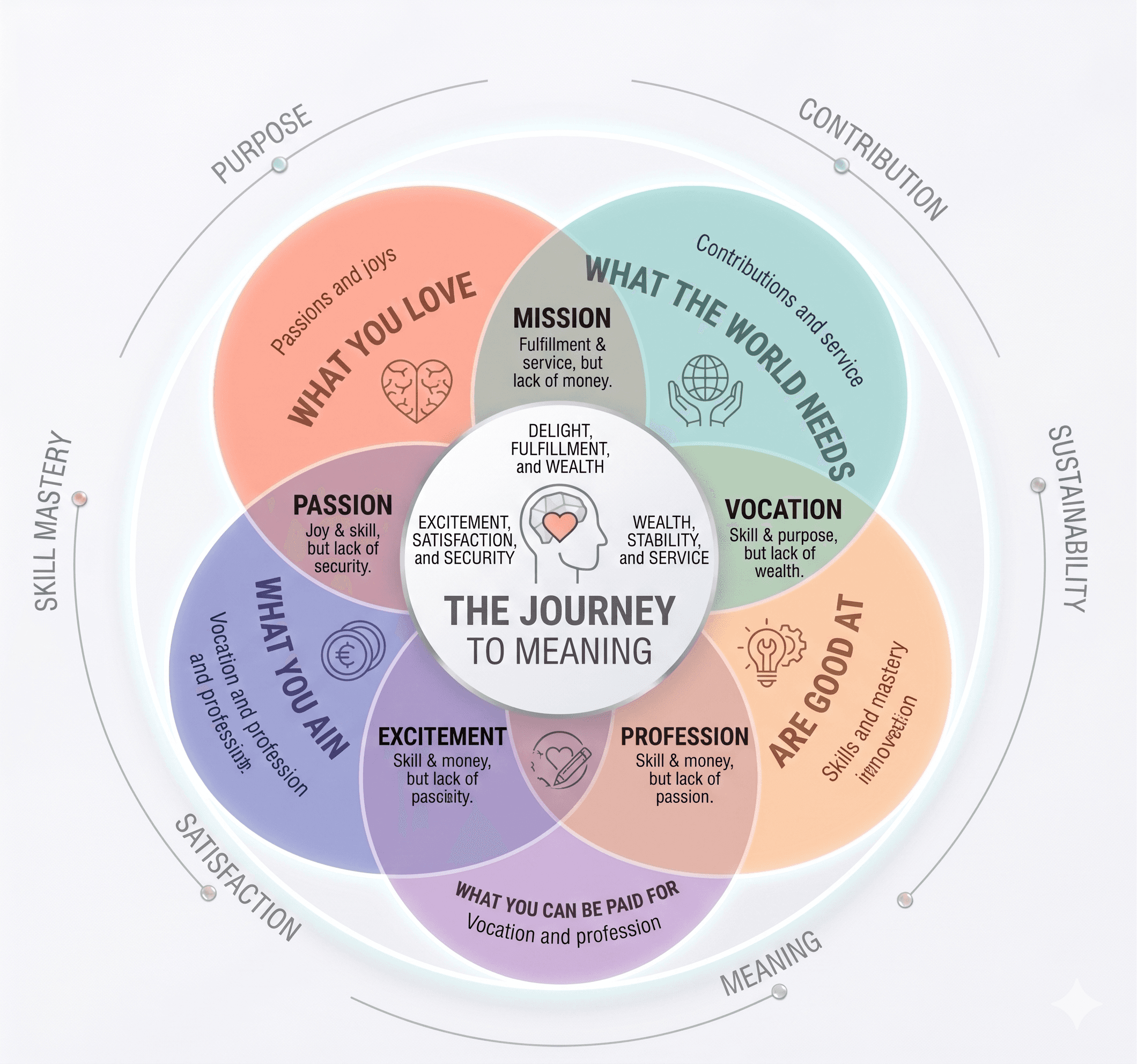
Ikigai
Making my portfolio more impressive
How to value your best skills (e.g, write an essay, make a website)
How and where can I apply those skills
Make a CV
How to look for what you want to do in the future”
Ruslan Nurumbetov
Business Administration - Kazakhstan “Btw, is it alright that I've given you more work by recommending you to my friends😅?”
Private name
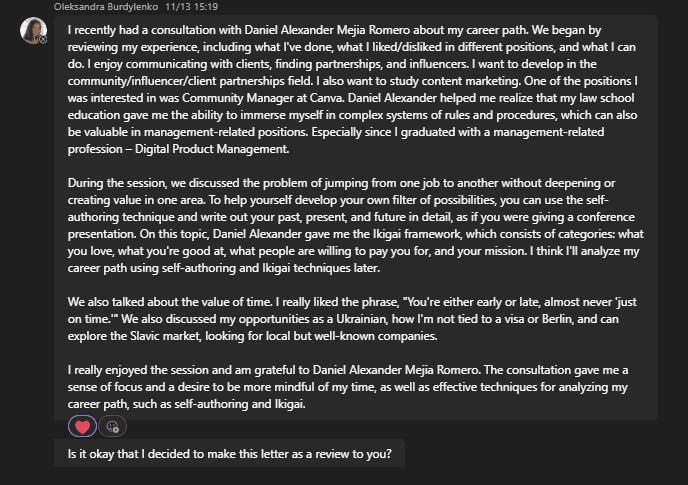
Business Adminisstration - Russia“I recently had a consultation with Daniel Alexander Mejia Romero about my career path. We began by reviewing my experience, including what I’ve done, what I liked/disliked in different positions, and what I can do. I enjoy communicating with clients, finding partnerships, and influencers. I want to develop in the community/influencer/client partnerships field. I also want to study content marketing. One of the positions I was interested in was Community Manager at Canva. Daniel Alexander helped me realize that my law school education gave me the ability to immerse myself in complex systems of rules and procedures, which can also be valuable in management-related positions. Especially since I graduated with a management-related profession – Digital Product Management.
Oleksandra Burdylenko
Design & Management Studies - UkraineDuring the session, we discussed the problem of jumping from one job to another without deepening or creating value in one area. To help yourself develop your own filter of possibilities, you can use the self-authoring technique and write out your past, present, and future in detail, as if you were giving a conference presentation. On this topic, Daniel Alexander gave me the Ikigai framework, which consists of categories: what you love, what you’re good at, what people are willing to pay you for, and your mission. I think I’ll analyze my career path using self-authoring and Ikigai techniques later.
Private name
Digital Product Management - UkraineWe also talked about the value of time. I really liked the phrase, ‘You’re either early or late, almost never ‘just on time.’’ We also discussed my opportunities as a Ukrainian, how I’m not tied to a visa or Berlin, and can explore the Slavic market, looking for local but well-known companies.
I really enjoyed the session and am grateful to Daniel. The consultation gave me a sense of focus and a desire to be more mindful of my time, as well as effective techniques for analyzing my career path, such as self-authoring and Ikigai.
Is it okay that I decided to make this letter as a review to you?”
Private name
Digital Product Management.“Hi! I followed your advice and wrote down what I want in life and my plans have changed. I’m ready to share them next week, this week I won’t be at the university”
Svetlana Lobunova
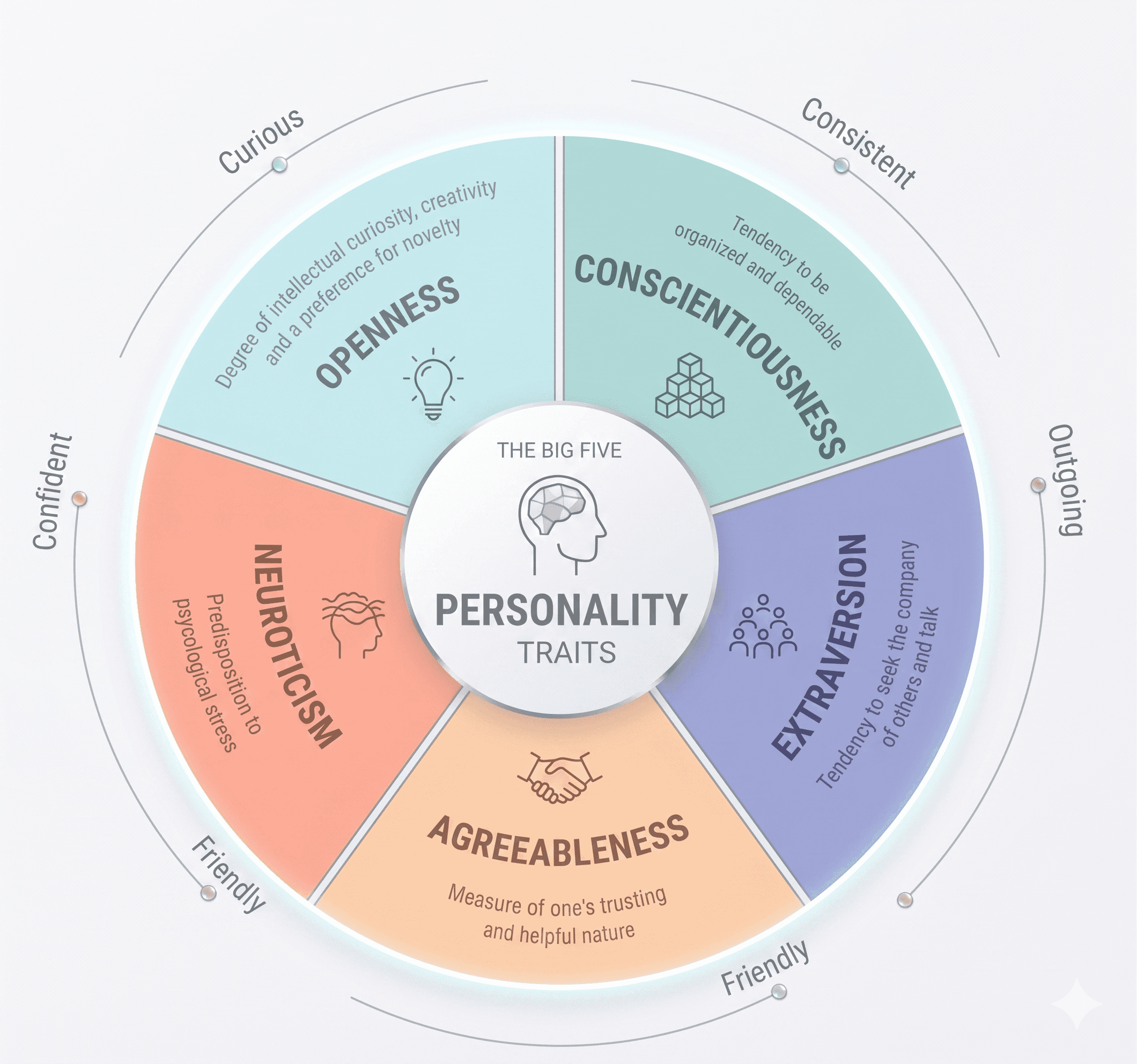
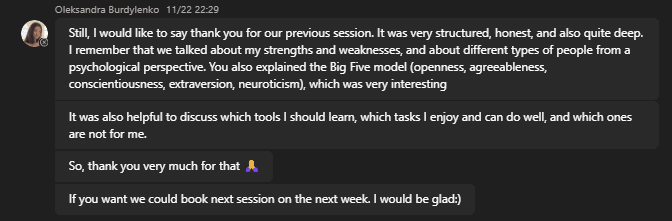
Art & Design - Russia“Still, I would like to say thank you for our previous session. It was very structured, honest, and also quite deep. I remember that we talked about my strengths and weaknesses, and about different types of people from a psychological perspective. You also explained the Big Five model (openness, agreeableness, conscientiousness, extraversion, neuroticism), which was very interesting
It was also helpful to discuss which tools I should learn, which tasks I enjoy and can do well, and which ones are not for me.
So, thank you very much for that 🙏
If you want we could book next session on the next week. I would be glad!)”
Oleksandra Burdylenko
Design & Management Studies - Ukraine“Thank you so much for your mentorship in this internship Daniel, I learned a lot from you and from your design skills. I can even say I learned more from you than from some professors Ive had in Uni. I believe you are a great designer and I wish you all the luck in your Masters and everything you do in life 🥺”
Marina Cuellar Sanchez
Information Design - Mexico“Hey Daniel. I have thought about our conversation and decided to draft my first CV as well as write an essay about what I do well and stuff. I think I will be done soon. Can we schedule a new meeting on Monday? Also, below is what I thought was important from our talk yesterday.
We have talked about:
Ikigai
Making my portfolio more impressive
How to value your best skills (e.g, write an essay, make a website)
How and where can I apply those skills
Make a CV
How to look for what you want to do in the future”
Ruslan Nurumbetov
Business Administration - Kazakhstan “Btw, is it alright that I've given you more work by recommending you to my friends😅?”
Private name
Business Adminisstration - Russia“I recently had a consultation with Daniel Alexander Mejia Romero about my career path. We began by reviewing my experience, including what I’ve done, what I liked/disliked in different positions, and what I can do. I enjoy communicating with clients, finding partnerships, and influencers. I want to develop in the community/influencer/client partnerships field. I also want to study content marketing. One of the positions I was interested in was Community Manager at Canva. Daniel Alexander helped me realize that my law school education gave me the ability to immerse myself in complex systems of rules and procedures, which can also be valuable in management-related positions. Especially since I graduated with a management-related profession – Digital Product Management.
Oleksandra Burdylenko
Design & Management Studies - UkraineDuring the session, we discussed the problem of jumping from one job to another without deepening or creating value in one area. To help yourself develop your own filter of possibilities, you can use the self-authoring technique and write out your past, present, and future in detail, as if you were giving a conference presentation. On this topic, Daniel Alexander gave me the Ikigai framework, which consists of categories: what you love, what you’re good at, what people are willing to pay you for, and your mission. I think I’ll analyze my career path using self-authoring and Ikigai techniques later.
Private name
Digital Product Management - UkraineWe also talked about the value of time. I really liked the phrase, ‘You’re either early or late, almost never ‘just on time.’’ We also discussed my opportunities as a Ukrainian, how I’m not tied to a visa or Berlin, and can explore the Slavic market, looking for local but well-known companies.
I really enjoyed the session and am grateful to Daniel. The consultation gave me a sense of focus and a desire to be more mindful of my time, as well as effective techniques for analyzing my career path, such as self-authoring and Ikigai.
Is it okay that I decided to make this letter as a review to you?”
Private name
Digital Product Management.“Hi! I followed your advice and wrote down what I want in life and my plans have changed. I’m ready to share them next week, this week I won’t be at the university”
Svetlana Lobunova
Art & Design - Russia“Still, I would like to say thank you for our previous session. It was very structured, honest, and also quite deep. I remember that we talked about my strengths and weaknesses, and about different types of people from a psychological perspective. You also explained the Big Five model (openness, agreeableness, conscientiousness, extraversion, neuroticism), which was very interesting
It was also helpful to discuss which tools I should learn, which tasks I enjoy and can do well, and which ones are not for me.
So, thank you very much for that 🙏
If you want we could book next session on the next week. I would be glad!)”
Oleksandra Burdylenko
Design & Management Studies - Ukraine